



In the first part of this series , we explored Levels 0–2 and why successful process mapping starts with the big picture.
Now let’s look at the operational levels where Business Analysts spend much of their time.
Level 3 – The Sub-Process
Level 3 breaks a business process into detailed activities, making it ideal for requirement elicitation, process analysis, solution design, and gap analysis. It’s one of the most commonly used levels in Business Analysis because it explains how work is actually performed.
Level 4 – Task Level
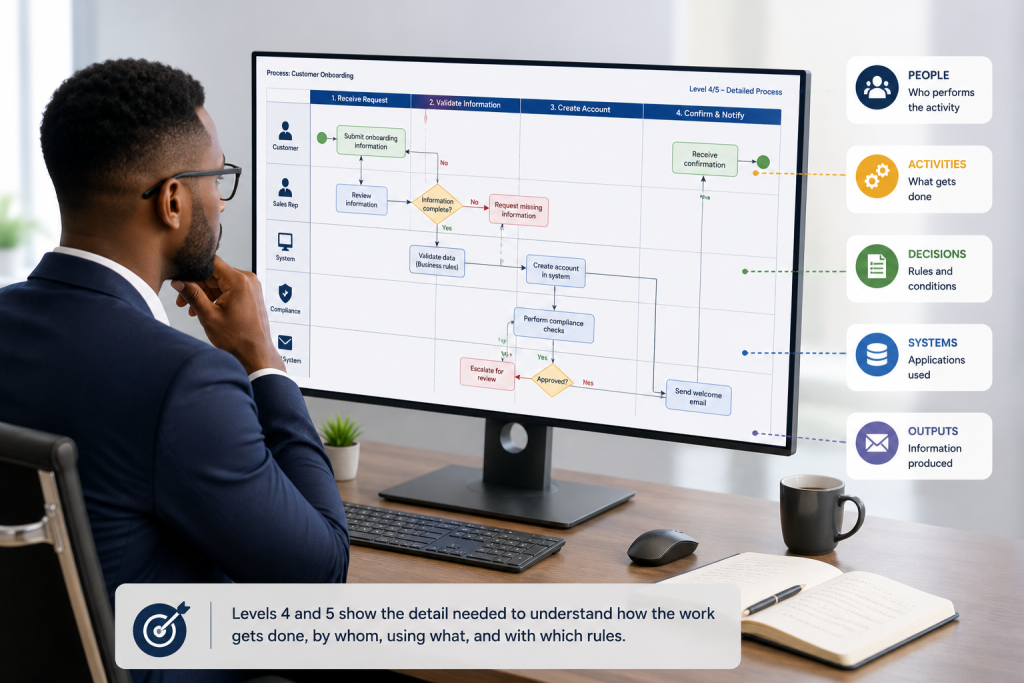
At Level 4, activities are decomposed into the individual tasks performed by users.
This level supports the creation of Standard Operating Procedures (SOPs), user manuals, work instructions, and training guides, helping organisations standardise the way work is performed.
Level 5 – Work Instructions
Level 5 provides the most detailed documentation.
It explains exactly how a task should be completed, often including screenshots, navigation steps, business rules, validation messages, and exception handling. This level is invaluable for operational teams, trainers, support teams, and new employees.
The Right Detail for the Right Audience
A CEO doesn’t need Level 5 work instructions.
Likewise, a new employee can’t perform their role using only a Level 0 process map.
Different stakeholders require different levels of information, and effective Business Analysts know how to adjust their communication accordingly.
Final Thoughts
One of the biggest differences between a junior and an experienced Business Analyst is knowing when to zoom in and when to zoom out.
Process mapping isn’t about producing detailed diagrams. It’s about creating clarity, improving communication, and helping organisations understand how work is performed so meaningful improvements can be made.