



One of the biggest mistakes I made early in my Business Analysis career was trying to map an entire business process on a single page.
The result?
A diagram so large that nobody wanted to read it. Stakeholders became confused, discussions lost focus, and instead of creating clarity, I created complexity.
Over the years, I learnt one of the most valuable lessons in Business Analysis and Business Architecture:
Not every stakeholder needs the same level of detail.
That’s why process decomposition exists.
Whether you’re a Business Analyst, Business Architect, Process Analyst, or Continuous Improvement professional, understanding process levels helps you communicate effectively with every audience.
Level 0 – The Enterprise View
Level 0 provides the highest-level view of an organisation. Think of it as the 30,000-foot view.
At this level, you aren’t interested in individual tasks. Instead, you identify the major business capabilities or value streams that enable the organisation to operate. This view is typically used when engaging executive leadership and discussing strategy.
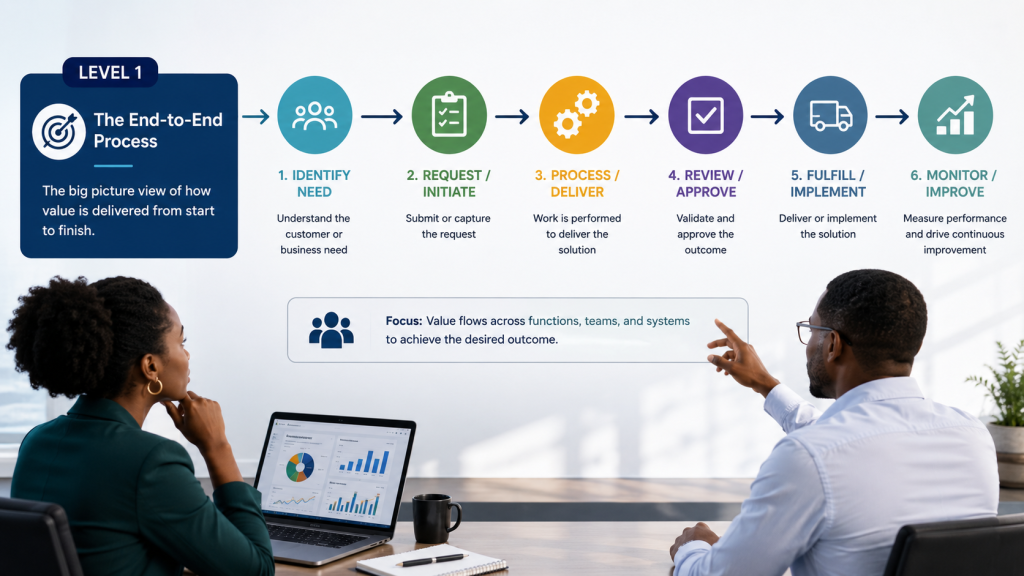
Level 1 – The End-to-End Process
Level 1 breaks the enterprise view into its major stages.
Rather than diving into detailed activities, it provides an end-to-end picture of how work flows across the organisation. This level is particularly useful during discovery, process workshops, business case development, and transformation initiatives because it helps everyone understand the overall journey before exploring the details.
Level 2 – The Business Process
Level 2 begins to reveal how work is actually performed.
Business Analysts start identifying process owners, inputs and outputs, business rules, decision points, and process handoffs. This is often where improvement opportunities first become visible.
Why Starting at the Top Matters
One of the most common mistakes I see is Business Analysts jumping straight into detailed process mapping before understanding the bigger picture.
Starting with Levels 0–2 provides context, aligns stakeholders, and ensures everyone shares the same understanding before moving into detailed analysis.
Next week, we’ll explore Levels 3–5 and discuss how experienced Business Analysts determine the right level of detail for every audience.