


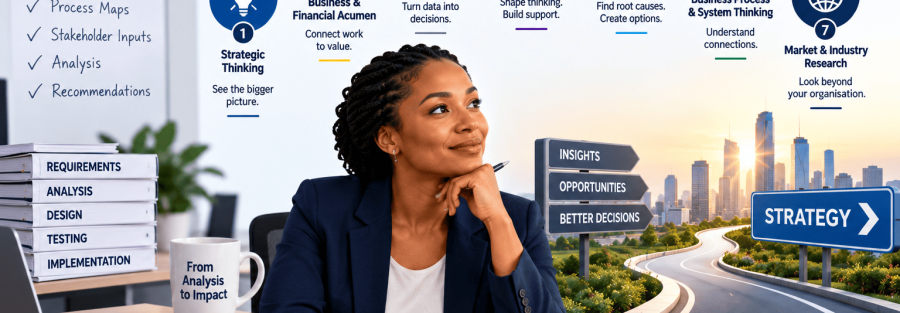
There’s a moment in every Business Analyst’s career when the job stops being about writing requirements documents and starts being about shaping the direction of the business itself. Some BAs never reach that moment not because they lack talent, but because nobody told them what separates a requirements-gatherer from a strategic partner in the room.
If you’ve been asking “what’s next for me?” after years of user stories, process maps, and stakeholder interviews, this is your answer. Below are seven skills that move you from executing what leadership decides to helping leadership decide with a clear line drawn toward Business Architecture, one of the most natural and rewarding destinations for a BA ready to go strategic.
1. Strategic Thinking
Tactical BAs solve the problem in front of them. Strategic BAs ask whether it’s the right problem to solve in the first place. Strategic thinking means zooming out from a single requirement or project to ask how it fits the organization’s broader goals, where it sits on a 12–24 month horizon, and what it enables or blocks down the line.
How to build it: Before starting any piece of analysis, write one sentence connecting it to a company-level goal. If you can’t, ask why the work is being done at all.
2. Business and Financial Acumen
You can’t advise on strategy if you don’t understand how the business actually makes money, where its costs sit, and what trade-offs leadership is weighing. Strategic BAs read financial statements, understand unit economics, and can connect a requirement back to revenue, cost, or risk without being handed a slide deck.
How to build it: Study your organization’s P&L structure or business model canvas. Practice translating a technical or process finding into a dollar-value business impact.
3. Data Analysis and Data Storytelling
Strategic influence rarely comes from data alone or narrative alone it comes from combining both. A BA who can pull the right data and wrap it in a clear business story becomes the person decision-makers seek out before a big call, not after.
How to build it: Practice the “so what” test. After every chart or metric you present, force yourself to add one sentence explaining why it matters to the business, not just what it shows.

4. Stakeholder Management and Influence
Traditional BA training teaches you to manage stakeholders gather their input, keep them informed, resolve conflicts. Strategic BAs go further: they influence direction by bringing insight stakeholders didn’t have, framed in language executives act on.
How to build it: Practice translating findings into business impact statements. Not “the system has a data quality issue” but “this data quality issue is costing us an estimated 12% in reporting accuracy, which affects three board-level KPIs.”
5. Problem Solving and Critical Thinking
Junior BAs document what’s asked for. Strategic BAs question the ask itself, surface root causes instead of symptoms, and weigh multiple options before recommending a path. This is the difference between being a scribe and being a thinking partner.
How to build it: For your next requirement, don’t just document the “what.” Draft two or three viable approaches with pros, cons, and cost implications, and make a recommendation.
6. Business Process and System Thinking
Most BAs are trained to map a process end-to-end: inputs, steps, outputs, exceptions. That’s valuable, but it’s tactical. Strategic BAs learn to see the system the process lives inside how a change in onboarding ripples into retention, how a “small” workflow fix in operations quietly shifts unit economics elsewhere.
How to build it: Practice asking “what else does this touch?” before finalizing any requirement. Map second-order effects across teams, not just the happy path within one.
7. Market and Industry Research
A BA who only looks inward at internal systems and internal stakeholders can optimize what already exists. A BA who also looks outward, at competitors, market shifts, and industry trends, can help the business decide what to build next. This outward lens is what turns analysis into genuine strategic input.
How to build it: Set a recurring habit of reading one industry report or competitor update a week, and ask how it changes or confirms the assumptions behind your current projects.
The Intent Behind Upskilling This Way
None of these seven skills require you to quit your BA role and start over. They require you to do the job you already have with a wider lens asking “why” one level higher, and “so what” one level further, than the requirements document strictly demands.
That’s the real bridge from Requirements to Strategy: not a title change, but a habit change. Business Architecture is simply the discipline that rewards you formally, and often financially for having built that habit already.
Ready to make this shift deliberately?
If you recognize yourself in even three of these seven skills, you’re closer to a strategic BA or Business Architecture role than you think — you just need a clear plan to close the gap. That’s exactly what we help with at MyBACoach.
Book a free discovery call and we’ll map out where you already have strategic strengths, where the gaps are, and what a realistic path to your next role looks like.